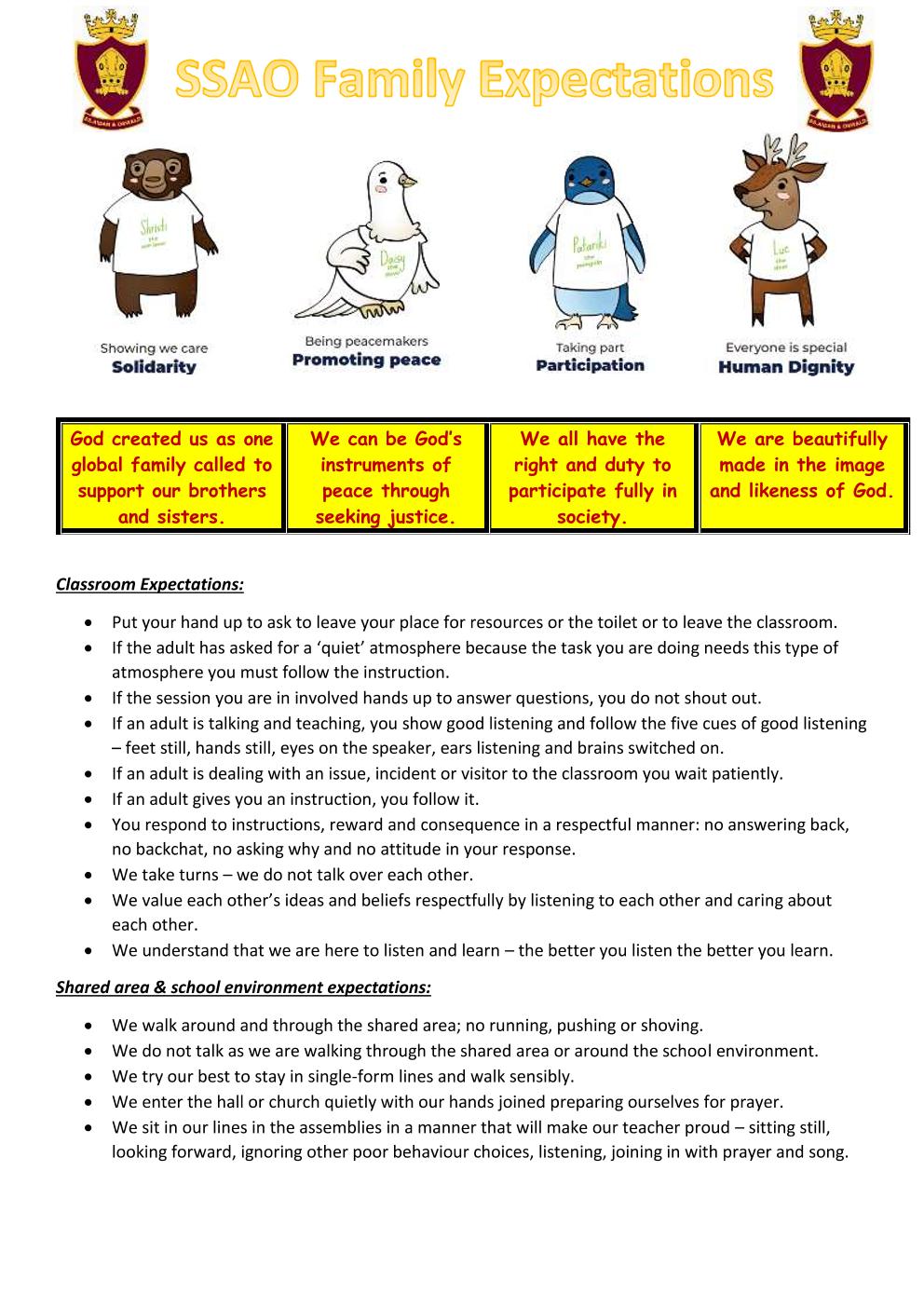
Please see our latest Behaviour and Anti-bullying Policy.

|
Expectations and Behaviour Letter February 2024 | [pdf 779KB] |

|
Rationale
This policy is rooted primarily in the Gospel values which underpin the school’s Mission Statement. ‘The Statements to Live By’, which form an integral part of the Mission Statement, also reflect the British values which are promoted in the broader community we serve.
The school’s Mission Statement encourages the children to remember that we are all special - unique and different, and all of us share in the wonderful revelation that we are made in the image and likeness of God. Therefore, we remember that other people are special. We try to be loving caring people following the ways of Jesus special by being thoughtful, considerate and charitable. Through our actions we can have a truly special place at the heart of our community.
Through our ability to behave well, with respect, reconciliation and resilience we can make each day a special day. We have adopted a Restorative Justice Approach in order to ensure that the children understand how others are affected by inappropriate behaviour. This is done by actively engaging participants in a process which separates the deed from the doer and rejects the act not the actor, allowing participators to make amends for the harm caused. We believe that this approach acknowledges the intrinsic worth of the person and their potential contribution to the school community. We are also aware that we need the co-operation and support of the parents of our children if a behaviour policy is to be effective.
Ofsted (2015) noted that, “The behaviour of the pupils is outstanding.” It additionally commented that, “The school’s systems to encourage good behaviour are understood by pupils and applied consistently by staff, who have high expectations of pupils’ behaviour and attitudes to learning.” The most recent RE inspection (2018) commented on behaviour as a key strength of the school, “the outstanding behaviour of the pupils and their respect and tolerance for each other.” The RE Inspection Team (2018) commented that, “Parents talk enthusiastically about the strong relationships formed between parents, pupils and staff. The school is always willing to listen to and support families in as many ways as they possibly can.
Staff are recognised as going the extra mile to help and nurture children and their families and the wider community.” Every community needs a set of values and an atmosphere of order for the benefit and safety of all. In our school the aim is to help each child maximise his/her talents and opportunities and to encourage and promote actively good standards of behaviour. Within our Catholic, Christian ethos, we acknowledge individual and collective weaknesses which, from time to time, offend others in our community. These times can be seen as opportunities to practise forgiveness and reconciliation, to make amends and to reaffirm the values of the school community.
Guidelines for Rewards and Sanctions in School
Promoting Good Behaviour
It is important that we try to remain as positive as possible at all times. We have a supportive school with a caring ethos. In order to make the most of this it is expected that there will be a number of means within the school of rewarding and celebrating achievement and good behaviour.

In Class
Some or all of the following are used within the classroom or playground setting:
Regular praise from any adults involved for good work and positive behaviour;
The maintenance of wall displays demonstrating work of which the children are proud;
- Star of the Day Award;
- Marbles in the jar challenge;
- “Spots” collection cards;
- Class dojo system;
- Stickers;
- Raffle Tickets;
- Postcards home;
- Impressive work included in the individual Records of Achievement;
- Visit to a Headteacher to celebrate a piece of impressive work;
In Key Stage Assemblies
These are held weekly, on a Friday.
- Star of the Week Certificates;
- Opportunity for children to show and talk about their achievements when either representing the school or taking part in an out of school activity;
- Lunchtime Behaviour Awards;
- Playground Role Model certificate – presented by the School Council;
- Attendance Awards (class);
- Role-model in class – presented by the GIFT Team
End of Year
A special awards assembly is held to celebrate the achievements of the school and pupils over the year. The awards include:
- The School Councillor Awards;
- The Green Ambassador Awards;
- The School Chaplain / GIFT Awards;
- The Community Team Award;
- The Nursery Clare Drogan Awards;
- The Year 2 Pat Fallon Awards;
- The Year Six Endeavour Awards;
- The Mrs Helen Fitzpatrick Award (choral speaking);
- The Mrs Pat Jones Award (music);
- The Mr Peter Moore Award (sport);
- The Moira Harwood Award (caring)
- Attendance Awards;
- Year Six are presented with their Records of Achievement;
Other Opportunities to Celebrate
Other Opportunities to celebrate include:
- Sacramental Programme Certificates;
- School Council Mission Statement Awards presented at our Masses
Rules and Sanctions
Whole School
At SS Aidan and Oswald’s we follow the Code of Conduct outlined below:
We will respect other people, grown-ups and children by caring about their feelings and their property.
We will respect other people by remembering to use polite words, such as ‘please’, ‘thank you’, ‘sorry’, and ‘excuse me’.
We will respect other people by never calling them names, teasing or bullying them.
We will respect other people by listening to them, by not interrupting them and by waiting for our turn. We will respect ourselves by trying to do our best at all times, by being honest with ourselves and others and by accepting responsibility for our actions.
We will respect our school by caring about its appearance, its resources and materials and its reputation.
We, adults and children, will try to work together as a team so that everyone can make the most of their abilities and talents. We will follow these rules to keep our class, school and playground safe, happy and pleasant places to be in.
Examples of Unacceptable Behaviour: bullying, fighting, physical harm to others, persistent bad manners, calling hurtful names (particularly relating to appearance, homophobia, faith, disability, family background, race or gender), disobedience/telling lies, defiance, racial remarks, swearing, spitting, not listening, answering back/arguing, destruction / damage to resources, damage to school building, theft, stopping others from working, non-completion of work through own misbehaviour, leaving the classroom / school premises without permission.
All adults in school will monitor the children’s adherence to these rules. There will be reminders about the rules, rewards and sanctions in assemblies. We use Restorative Approaches to support our behaviour management systems as this enhances our sense of community. This approach also links with our Mission Statement and weekly Statements to Live By.
In Class
At the beginning of the school year teachers discuss and invite contributions to the class rules. These are then agreed and displayed within the classroom. The sanctions procedures are designed to provide lots of steps and opportunities for the children to redeem themselves and rectify poor behaviour. These may vary from time to time, but will follow this principle:
Being seated in a particular area of the classroom for a defined time;
Completing work in the parallel year group class for a defined time (ABC form completed when this applies);
Loss of part of playtime or lunchtime
Sent to Key Stage Assistant Head or a Headteacher (ABC form completed when this applies);
Parent / guardian contacted and invited into school to discuss the child’s behaviour. Prior to any of the above sanctions being applied, a verbal warning is given. Restorative Justice Approaches can be used as part of any of the above.
Referral to a Head Teacher
If it becomes necessary for the Assistant Head to refer a child to a Headteacher, then the following stages may be implemented:
STAGE 1 Discussion / investigation of incident(s) leading up to the referral and explanation of what will happen next.
STAGE 2 Letter sent home explaining the concerns. Further discussion with the child and consideration of strategies to avoid further incidents.
STAGE 3 Letter sent home inviting parents to a meeting to discuss their child’s behaviour. Further intervention strategies and programmes will be considered.
STAGE 4 Child is placed on a Contract of Behaviour. This is done during a meeting with the parents, child and class teacher, where possible. The child is seen on Friday afternoon by a Headteacher to review their progress and contact made on a weekly basis to consider the week’s behaviour. A review date is set with parents.
Restorative Conferencing can be instigated during any of the above stages. As part of this approach a Conferencing Contract will be agreed to ensure that all involved have been able to express their thoughts and feelings and that a signed agreement exists detailing any behaviour changes required.
Occasionally, external support may be sought and agencies informed as appropriate.
It is invariably the case that the involvement of parents in partnership with the school is sufficient to address more serious incidents of unacceptable behaviour or persistently poor conduct. In rare situations the Head teacher may need to exclude a child from school. In this case the Oldham LA guidelines will be adhered to.